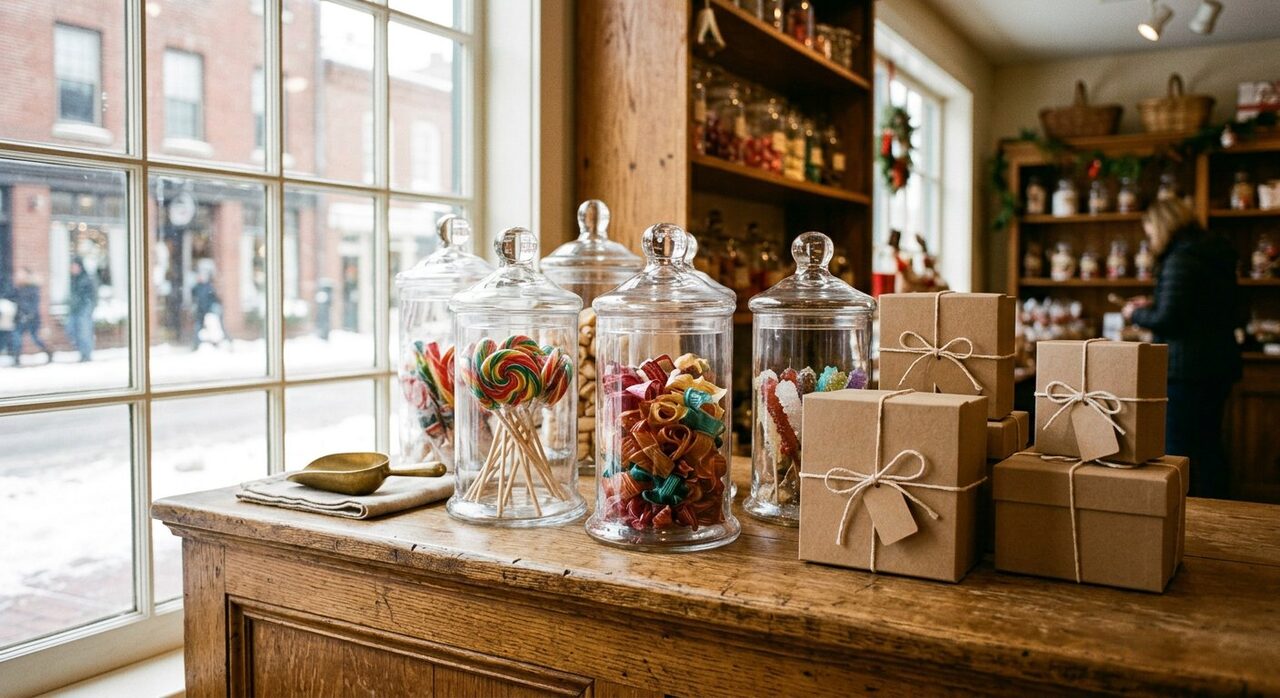
Nothing looks prettier on a bookshelf or dining sideboard than a clear bell jar of jewel-toned drops catching late-afternoon light. Yet anyone who has left unwrapped handmade ribbon candy in an open bowl during a humid July week knows what happens next: first the mirror-gloss surface turns slightly tacky, and a few days later a soft matte frost creeps across the edges.
That frosted look isn’t spoilage—it is simple physics. Understanding what is happening on a microscopic level makes storing artisan sweets effortless.
The Hygroscopic Nature of Amorphous Sugar Glass
When cooked to the hard-crack stage and cooled rapidly on marble, molten sugar solidifies without forming crystals—technically becoming a true amorphous glass, much like windowpane silica. Because its moisture content sits below two percent, it is fiercely thirsty for water vapor whenever indoor relative humidity climbs past roughly fifty-five percent.
As invisible water molecules from humid room air settle onto an exposed candy surface, a paper-thin outer layer dissolves slightly (the sticky phase) and then reorganizes into tiny, orderly grains that scatter light instead of letting it pass straight through (the frosted matte phase). Flavor remains intact, though the optical clarity softens.
Rule Number One: Skip the Refrigerator
Well-meaning gift recipients often tuck boxes of Nebula Nocturne Lollipops or Borealis Ribbon Twists into the fridge during warm weather, thinking cool air protects them the way it protects chocolate truffles. With hard candy, refrigeration backfires twice:
- First, household refrigerators are surprisingly damp environments whenever produce drawers are nearby.
- Second, the moment you bring a chilled 38°F lollipop out into a 72°F kitchen, room moisture condenses instantly across the cold sugar surface—just like dew beading on the outside of an iced tea glass.
Choosing Jars That Actually Seal
Decorative glass candy dishes with loose-resting lids look charming for an evening gathering, so our studio rule of thumb is simple: put out only what your guests will enjoy over a day or two, and keep the reserve tucked inside an airtight gasketed jar or its original sealed tin.
- Silicone-gasketed Bail Jars & Screw-Top Tins: Best for humid coastal or midwestern summer months.
- Keep Cellophane Twists On Until Serving: Individually wrapped cubes and lollipops carry their own micro-barrier against room air, preventing pieces from kissing and fusing together inside a jar.
- Food-Safe Desiccant Packets: If you live in Florida, the Gulf Coast, or keep candy through sticky August weeks without central air conditioning, taping one small food-grade silica packet inside the underside of your jar lid keeps clarity pristine for months.
How Long Do Small-Batch Hard Candies Keep?
Stored cool, dry, and sealed away from direct sun, our sculpted lollipops and cut cubes maintain crisp snap and vibrant flavor impressions for four to six months—though thin, heavily aerated pulled pieces like Borealis Ribbon Twists are always liveliest within the first eight to ten weeks while their forty-eight micro-stripes are at peak shatter.