Small-Batch Handcrafted Sweets • 2741 Blaisdell Ave, Minneapolis, MN 55408
Craft & Discipline

Five unhurried stages—and three minutes when everything has to move at once.

Hard candy looks calm and permanent sitting in a bell jar, yet making it by hand is closer to glassblowing than baking. Here is how each batch takes shape on our Blaisdell Avenue tables.

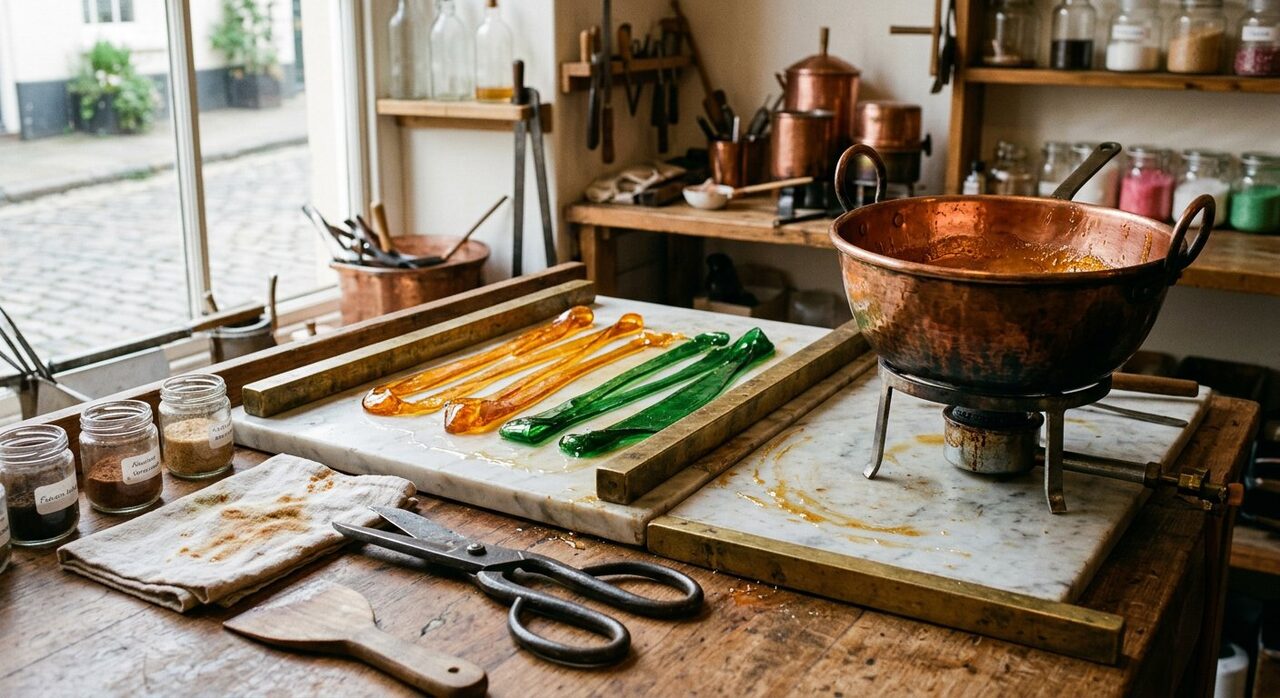
Hammered copper candy pot, marble slab with brass bars holding amber and green molten sugar ribbons, and heavy steel shears
Why Copper & Stone Still Matter

Tools that haven’t needed reinventing since 1910.

Heavy-gauge copper responds the instant we turn down the flame, preventing residual heat from scorching a delicate clear pour into unintended bitterness. Once lifted off the burner, the batch meets two-inch-thick Carrara marble framed by square brass bars.

Stone draws heat steadily out of the underside of the molten pool, giving us a smooth skin we can fold inward with a palette knife so the entire mass cools evenly instead of forming brittle edges around a liquid middle.

From Burner to Cellophane

Step-by-Step Through a Kettle Run

01

Small-Kettle Firing to the Hard-Crack Window

We cook in six- to eight-pound batches, watching clarity and thermometer readings down to the single degree—adjusting slightly for barometric pressure and indoor humidity here in Minnesota. Pull the kettle two degrees early and drops turn sticky by Friday; leave it two degrees late and subtle top notes mute out.

02

Dividing & Layering on the Marble Slab

Because every Bellglass candy hides a multi-stage flavor twist, one kettle pour gets divided immediately between separate brass-barred bays on the marble table. Each bay receives its own distinct aromatic profile and jewel-like tint while still fluid.

03

Aerating on the Wall Hook for Satin Sheen

Portions destined for our Solstice Horizon Drops, Borealis Ribbon Twists, or mosaic tiles are thrown onto our steel wall hook and stretched, folded, and pulled fifty to seventy times by hand. Each fold traps microscopic parallel air channels that turn clear amber sugar into shimmering ivory or copper satin—changing both how light reflects and how swiftly flavor blooms on the tongue.

04

Sculpting Before the 190°F Threshold

Below roughly 190°F, sugar stiffens into rigid glass. Within a tight three-minute window on our warming canvas, we stack geometric rods for Glasshouse Mosaic Cubes, crimp forty-eight-stripe waves for Borealis Ribbons, or pour concentric stages around birchwood sticks for our sculpted lollipops.

05

Hand-Shearing, Inspection & Moisture Sealing

Pulled logs are drawn out into slender ropes and snipped rhythmically with heavy steel candy shears, rotating ninety degrees on alternate cuts to form crisp pillow cushions. Once cool, every piece is inspected for sharp edges and sealed immediately in clear confectionery cellophane, hinged tins, or ground-lid jars.

What Your Palate Notices

Hand-Worked Kettle Candy vs. Industrial Stamped Drops

Even before the flavor twist kicks in, adults usually notice the physical feel of hand-worked sugar within three seconds. Here is why.

Characteristic Bellglass Studio Kettle Craft Mass-Market Supermarket Candy
Surface Texture Fire-polished or satin-pulled by hand; smooth, rounded dissolves without rough mold seams. High-speed rotary die stamping often leaves sharp flashing seams and tiny trapped air pits.
Flavor Arc Two or three distinct sections folded or cast together so taste shifts as layers thin. Single homogeneous vat mixture—tastes identical at second one and minute four.
Visual Depth Light refracts through alternating clear glass and hand-aerated micro-channels. Uniform flat translucency or heavy opaque dye saturation.
Batch Freshness Scheduled around direct studio inquiries in six- to eight-pound pours. Manufactured in multi-ton runs for long warehouse distribution cycles.